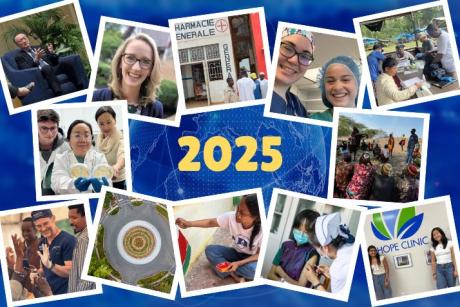
Peer facilitators celebrate completion of a summer 2023 project to reduce intimate partner violence in Kenya, one of dozens of global health-related Bass Connections projects in recent years.
Published October 16, 2025, last updated on October 23, 2025 under Education News
Like many young adults, Trisha Kibugi has heard a lot about the danger of human papillomavirus (HPV), a sexually transmitted infection that is the most common cause of cervical cancer globally. But it wasn’t until Kibugi came to Duke that she learned about another HPV risk: cancers of the head and neck.
“Not many people understand that HPV can cause head and neck cancers,” says Kibugi, a second-year student in the DGHI Master of Science in Global Health program. “But it’s a significant risk, because head and neck cancers are often not diagnosed until later stages, when you’re more likely to have worse health outcomes.”
This fall, Kibugi joined a Bass Connections project that is working to understand the reasons underlying that knowledge gap – and possible ways to close it. Led by Nosayaba Osazuwa-Peters, Ph.D., an associate professor of head and neck surgery and global health, the team is studying how to improve HPV vaccination rates among adults between the ages of 27 and 45, a cohort recently included in the U.S. Food and Drug Administration’s expanded recommendations for HPV vaccination. The group will examine how communication about the risks of HPV-associated cancers influences vaccine decisions, particularly among vulnerable groups.
“I’m a big fan of Bass Connections, because you really get to apply the things you are learning in classes,” says Kib Kibugi ugi, who last year was part of a team analyzing how the fragility of national systems impacts humanitarian aid efforts in South Sudan. “If you want to understand what a career in research looks like, that’s what Bass Connections is. It’s working with people from different disciplines and with different strengths to drive research forward.”
Begun in 2013, the Bass Connections program funds interdisciplinary teams of faculty, graduate and undergraduate students to work on year-long projects addressing complex societal issues. Kibugi’s team is one of a dozen global health-related Bass Connections projects launching this fall, addressing issues such as antimicrobial resistance, how climate change is affecting risks of malaria outbreaks, expanding access to surgery in rural areas, and the challenge of providing medical services in conflict zones.
“It’s really an ideal way to give students experience in community-based research, where they are working in diverse settings and as part of diverse teams,” says Aunchalee Palmquist, Ph.D., an associate professor of the practice of global health and DGHI’s director of graduate studies.
Palmquist is co-leading a Bass Connections team studying the impact of heat exposure on communities in Sri Lanka, which have been experiencing a spike in chronic kidney disease linked to rising temperatures and water contamination. The students’ efforts will augment ongoing research led by Nishad Jayasundara, Ph.D., an assistant professor with DGHI and the Nicholas School of the Environment who has been working to understand what is causing the surge and how to prevent future cases.
“It’s harder and harder to find funding for this kind of global health research, and to support students in getting firsthand experience in fieldwork,” Palmquist says. “Bass Connections is an incredibly important resource in maintaining these kinds of projects.”

Members of a Bass Connections team in...
The program has also become a vehicle for mobilizing research on emerging societal issues, such as the humanitarian crises resulting from geopolitical conflicts. Three of this year’s projects in the global health theme are working to document health and environmental impacts of the Israel-Hamas conflict. Continuing a partnership launched last year with the Provost’s Initiative on the Middle East.
“It’s one of the most rewarding things I’ve done,” says Rebekah Boyd, a DGHI Global Health Pathway Fellow who last year led a team working to document treatment needs for Gazan children with congenital heart disease, which is continuing its work this year. “The students I worked with last year and this year are just so dedicated. They’re so passionate, and it just gives you hope.”
Boyd, a resident in cardiothoracic surgery at Duke, grew up in Gaza, where her parents run a nonprofit organization that connects Gazan refugees with cardiac care. She says news of the recent ceasefire between Israel and Hamas has raised hopes that children may soon be allowed to leave Gaza for heart treatments.
“We’re hoping that we can move very quickly to find these kids and get them plugged back into the care they need,” she says.
That potential to make an immediate impact on a real-world problem has always been at the heart of Bass Connections’ appeal with students. But it’s especially meaningful in the wake of hits to funding for federal research and global health programs, says Kibugi, who is aiming to pursue a career doing data-driven research on cancer epidemiology.
“With all of the funding cuts, I think a lot of us have lost hope about what we are doing, or the possibility of our research going somewhere,” she says. “The fact that the Bass Connections team is still able to do this work gives me hope. No matter what else is happening right now, we’re able to do this project, and it’s going to have an impact on people’s lives.”
Want to Propose a Project?
The Bass Connections program is accepting proposals for 2026-27 projects through Monday, Nov. 3. In addition to the global health theme, Bass Connections is partnering with DGHI’s Climate and Global Health Initiative to support projects that will explore health impacts of climate change. Faculty interested in leading a project should read the proposal guidelines before submitting an application.