Students on a DukeEngage project in Eswatini, which constructed a water system for a primary school serving 300 children.
Published August 21, 2025, last updated on September 12, 2025 under Education News
Despite the funding cuts and freezes that have rippled across global and public health in recent months, many Duke students have been able to find opportunities to gain hands-on experience through summer internships and research. Catie Fristoe, a rising senior majoring in global health and psychology, was inspired by the stories she heard from her classmates’ summer experiences, and we asked her to interview a few of them. Fristoe, who spent the summer working with a global health nonprofit in Portland, Maine, says sharing these stories can be “a great way to keep up students’ hope, especially going into the senior year job search.”
Reena Kagan
Connecting Education and Health in Guatemala
Reena Kagan, a rising senior majoring in global health and neuroscience, had hoped to find a summer internship focused on healthcare policy. She says the widespread job cuts across global health made the search and application process for summer internships very frustrating and disheartening. She ended up getting an internship with Education and Hope, a non-profit organization in Guatemala that works to improve access to education and nutrition. While it wasn’t what she initially planned, she says the opportunity will shape her future career in global health.
During the summer, Reena worked on projects reviewing the organization’s data and met with different members of the community to gain a better sense of the organization’s impact. Her goal was to compile materials that could be shared with potential donors and used for internal purposes. While the experience was very different from what she planned, she says she learned so much and gained insight into a different side of work” in the global health field.

Reena Kagan, center, with community...
One unforgettable lesson was seeing the interaction between education and health. “I had thought of them as somewhat separate, but this experience has shown me how important it is to combine the two, because it is hard to achieve progress in one without also working to improve the other. In the same vein, the relationship between physical health and emotional/mental health is so inter-dependent; you can’t have one without the other,” she says.
A particularly memorable experience for Reena was visiting the home of a family whose children received services through the organization. She interviewed the mother, who had stopped going to school at age nine and was forced to work while she and her sisters were severely malnourished. Reena says it was moving to hear how hard the mother worked to support her three children, and how the meals and academic support her children received through the nonprofit allowed her to build a healthy, safe home environment.
Reflecting on the overall internship process, Reena encourages other students in global health to not reject an opportunity just because it doesn’t align with their vision. Although working for an education nonprofit wasn’t initialy her goal, the experience showed her the interdisciplinary nature of global health and gave her tools she can carry with her throughout her career.
Kate Seneshen and Ally Carey
Forging Their Own Path in Peru
For a second summer, senior global health majors Kate Seneshen and Ally Carey spent two months in Peru, working on anindependent research project on adolescent pregnancy. They continued a partnership begun last summer with Vidawasi, a local health center and nonprofit that is focused on decentralizing pediatric care in Peru’s Sacred Valley. Through Vidawasi, they conducted surveys and written interviews with teens and young mothers to collect data about education, resource access and views on reproductive health.
Ally shares that she never would have imagined spending two of her college summers doing fieldwork in Peru. The experience was “definitely much different than some of the great internships many of my friends [were] doing in New York and D.C.,” she says. Because of the many resources available at Duke, especially the amazing funding opportunities and staff in the Duke Global Health Institute, she and Kate were able to design and carry out a project on their own, under the mentorship of Ernesto Ortiz, M.D. a senior program manager with DGHI.
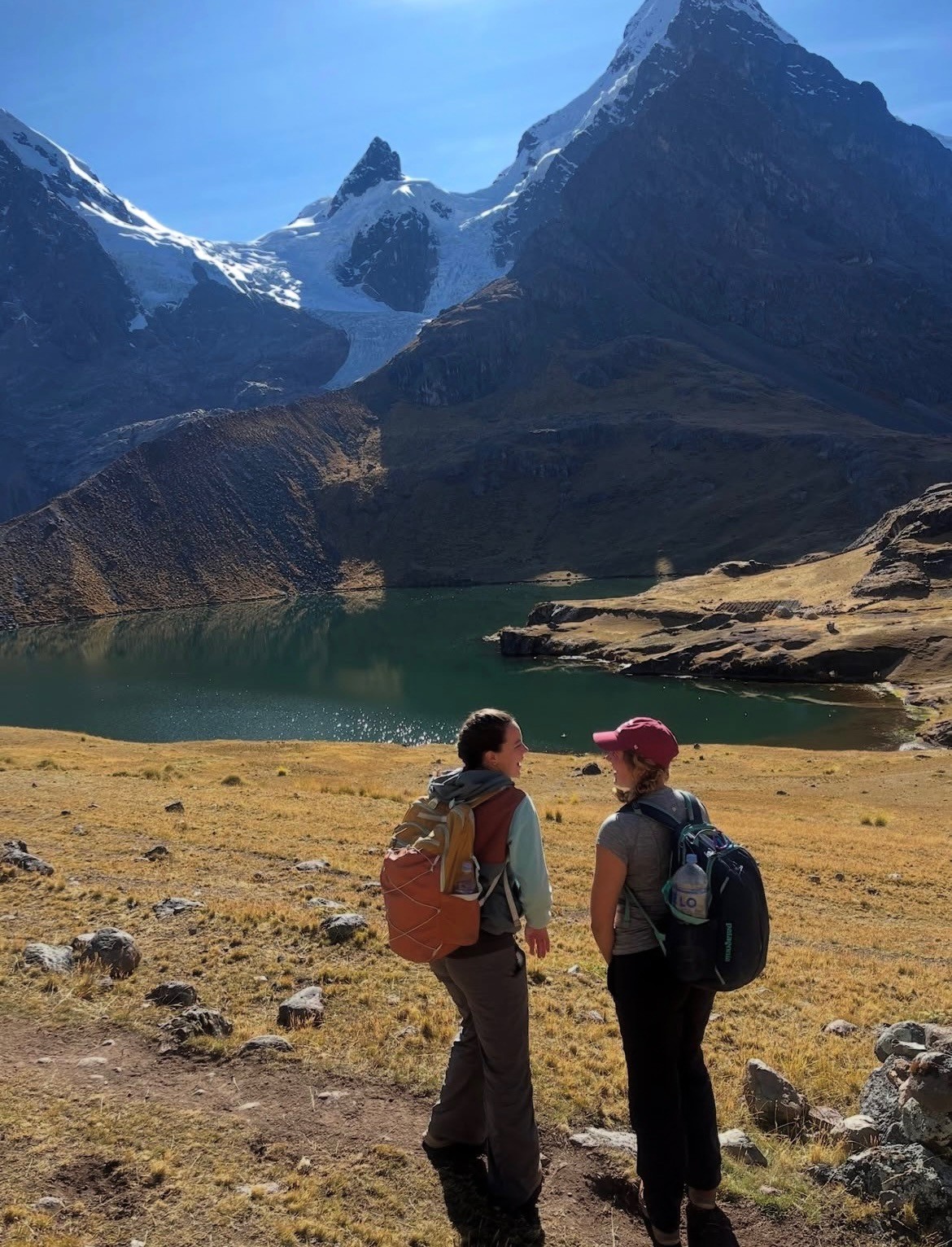
As a sophomore, Kate had hoped to gain experience abroad by joining the Duke Engage program in Cape Town, South Africa. She says not being offered a place in the program was a blessing in disguise, because it taught her to network and pursue her own research interests. She joined DGHI’s Student Research Training (SRT) program in Pamlico County, N.C., which gave her the research skills to co-design the Peru project with Ally.
Kate and Ally share that their most memorable experience of the summer was participating in a local parade, which involved learning the Panadero dance, a traditional dance performed for many holiday celebrations in Peru. Wearing braided extensions and ribbons in their hair, they danced in the parade from 6:30 a.m. to 11 p.m. two days in a row, a weekend they will never forget.
Reflecting on their summer experience, Kate and Ally say the biggest lesson was to expect plans to change and to trust the process. Delays in research approvals meant they weren’t able to collect all the data they needed last summer, which at first seemed like a setback. But returning for a second summer allowed them to learn more about the culture and lifestyles in Peru.
While they acknowledge global and public health are tough fields to get into right now, Kate and Ally say their summer research experience helped them learn more about what they may want to do after graduation. They tell students not to be discouraged and to use Duke networks and resources to create opportunities for themselves. They remind their classmates that “nobody has [their career] totally figured out, and it’s never too late to change your mind about what you want to do.”
Catherine Papa
Finding Community in Eswatini
Catherine Papa, a senior majoring in global health and biomedical engineering, spent the summer participating in a Duke Engage project in Eswatini, which partnered with a non-profit called Engineers in Action. Working with 11 other students from Duke and Cornell University, Catherine helped design and built a water system for 300 students at a primary school and led training on hygiene and upkeep of the system.
Like many Duke students, Catherine imagined herself working in a big city behind a desk, but she says she found so much more meaning from being in the field with community members. She says having to solve problems on site and working across cultural barriers helped her grow as a person and global citizen. Among her most memorable experiences was attending a soccer game in which many of the community members working on the project were playing. She says it felt good to be part of the community, cheering on new friends.

Duke students work on the project to...
Working in the Global South gave Catherine a new perspective on inequalities in health and opportunity. “To understand the inequality in the world as a concept is one thing, but to sit across from someone at the dinner table who you have come to see as a friend, and to see the inequality between the two of you just because of the country you were born in, is entirely more personal,” she says.
While she was working on an engineering project, Catherine says she saw how broadly global health connects to other fields, and she encourages global health students to bring their own passions and knowledge to their projects.
Catie Fristoe
Learning to Pivot in Portland
I went into my search for summer jobs looking for a public health experience in a major city like Boston, New York or San Francisco. I was hoping to gain more experience working for a state public health department, but I found it very difficult to find internship opportunities amidst all the budget cuts and freezes in global and public health. I ended up working with a nonprofit called Partners for World Health in Portland, Maine, that collects medical supplies and equipment from health facilities in New England and sends them to communities across the globe.
I spent my time learning every aspect of running a nonprofit, from managing volunteers to reorganizing the nonprofit’s medical supply sorting system. I learned countless lessons that will help guide my future career. The biggest lesson was that pivoting and problem solving was key. I had to learn to cope with and work around setbacks such as volunteers changing their schedules and changes in shipment timelines. There was even a spontaneous celebration for one volunteer’s 90th birthday.
Catie Fristoe spent the summer working...

While the internship was not exactly what I had expected to be doing with my summer, I was so grateful to have had the opportunity to work with and learn from the hundreds of volunteers who make Partners for World Health what it is. I was also able to establish a great connection with the nonprofit’s CEO, Elizabeth McLellon.
One particularly memorable experience was planning and attending a volunteer appreciation barbecue in July. I was able to take a step back and see how this organization served as a way for so many community members, all coming from unique and amazing backgrounds, to come together and support a project that they are passionate about. Every single volunteer showed up with the utmost appreciation and respect for the organization’s service-oriented mission.
Reflecting on my experience, I encourage my fellow global health students to always follow what they are most passionate about. Students should never be afraid to change their course or follow an unexpected path”. Global and public health jobs can be the best way to travel the world and live in areas that you might not otherwise have ever gotten to experience – never take that for granted.
People:
Related News

Research News
Herman Pontzer: Why exercise doesn’t burn more calories — and why that’s not the point
January 15, 2026