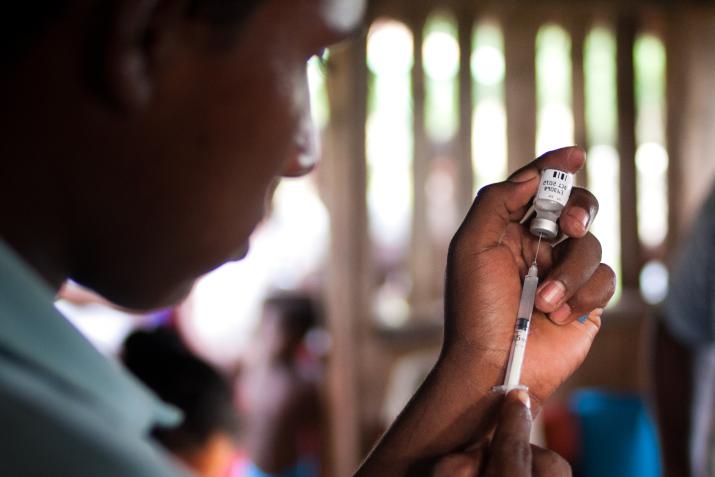
A nurse prepares a vaccine during a routine immunization campaign in Honduras. Photo credit: iStock.com
Published September 25, 2025 under Commentary
A group of Duke Global Health Institute experts sees promising goals in the U.S. State Department’s new global health strategy, but also some gaps and challenges in implementing what would be a major new direction for U.S. global health programs.
Published on Sept. 18, the America First Global Health Strategy is the U.S. administration’s first comprehensive statement of global health priorities since it froze most U.S. foreign aid programs earlier this year. The strategy describes a compelling national interest in global health investment, but calls for significant changes to how the U.S. carries out global health programs. It emphasizes direct, bilateral agreements with countries to accelerate co-investment and self-sufficiency, and prioritizes U.S efforts to control infectious disease outbreaks to prevent them from reaching its borders.

“The strategy rightly affirms that investment in global health is not charity, but a strategic foreign policy with significant implications for U.S. national security and diplomacy,” says Chris Beyrer, M.D., DGHI’s director. “Overall, it has the right priorities to build stronger, more resilient health systems around the world, but the changes it calls for also have some significant risks.”
The strategy’s long-term success, experts say, may depend on how effectively the U.S. manages transitions to new ways of working. Pulling back technical assistance too quickly could lead to failures in supply chains, data systems and the vast network of laboratories that support on-the-ground global health programs.
“The smart move is to keep transitional support in place, while strengthening shared data and surveillance systems and pressure-testing co-financing plans.” Says Jirair Ratevosian, Dr.P.H., a postdoctoral research fellow focusing on global HIV prevention and treatment strategy.
Ratevosian, who served as acting chief of staff for the President’s Emergency Plan for AIDS Relief (PEPFAR) from 2022-23, led a group of DGHI researchers in recommending changes to revitalize the 22-year-old HIV program. He says many of the plan’s proposals – such as phasing transitions gradually, reallocating resources to where they are most needed, adopting proven health interventions, and leveraging AI and digital tools – are the kind of actions that could make the America First strategy succeed.
“The strategy’s focus on integrating HIV, malaria, TB and polio programs is exactly what public health leaders have been calling for,” he says. “With its prioritization of private-sector service delivery, it creates a real opportunity to make programs more sustainable and scalable.”
While several DGHI experts praised the strategy’s emphasis on greater government investment from countries that have traditionally received aid, they caution the strategy’s aggressive timeline for cost-sharing could leave many health systems dangerously under-resourced in the near term, increasing risks of epidemics and gaps in treatment for preventable diseases that cause millions of deaths worldwide.
“Rapid withdrawal of U.S. assistance is a high-risk approach,” says Gavin Yamey, M.D., director of the Duke Center for Policy Impact in Global Health, which has studied the benefits of multilateralism and how countries manage transitions away from donor funding. He says the America First strategy “ignores the research evidence” on maintaining continuity of essential health services during periods of funding transition.
“We know that aid withdrawal should be gradual, and that the aid reductions should be carefully planned and phased,” he says.
Krishna Udayakumar, M.D., director of the Duke Global Health Innovation Center, says the strategy should be lauded for its focus on supporting frontline health workers, improving access to biomedical innovations, and prioritizing data and accountability. He agrees with the move away from traditional global health structures, which he says have often focused on a single disease or product.
“Shifting to integrated, country-led health systems, and away from narrow disease-based programs, is critical to the future,” he says. “Bilateral agreements with countries can help to identify clear shared priorities and ensure stronger metrics and accountability.”
But Udayakumar notes achieving the strategy’s vision will require “wholesale change to country-level and global health programs, and countries will need support in making the transition to a new model of engagement and financing. “The massive disruptions we’ve seen over the past few months have cost lives and left gaps that need to be addressed over the coming years,” he says.
Other DGHI experts are concerned by the strategy’s narrow focus on infectious diseases, which the document identifies as a top priority to prevent epidemic threats from spreading in the U.S. The limited scope could sideline critical programs that address the global spike in chronic diseases, maternal and child health and mental health, areas that drive long-term economic growth and human capital.

The strategy “takes a perspective that the only global health concerns for Americans are the threats related to potential global transmission of infectious disease.” Says Megan Huchko, M.D., director of the Duke Center for Global Reproductive Health, which conducts research and training programs to address maternal health issues such as prevention of cervical cancer in countries around the world.
Huchko points out that maternal and child health programs have been estimated to have a return of $87 for every dollar spent. “If U.S. funding for programs focused on the health and well-being of women and children is cut, we will see an increase in maternal, neonatal and infant mortality rates in low- and middle-income countries,” she says.
But sustaining global cooperation on such issues may be more difficult after the U.S. government’s moves to withdraw support from multilateral institutions such as the World Health Organization and GAVI, the Global Vaccine Alliance. “Today’s global health challenges—from pandemics to antimicrobial resistance to the health impacts of climate change—transcend national borders and tackling them requires strengthened, not weakened, multilateral cooperation,” Yamey says.