Duke global health master's student Breanna Barrett presents a research poster at the second annual Duke Global Mental Health conference on Oct. 7.
Published November 25, 2025, last updated on December 1, 2025 under Around DGHI
Key takeaways:
- More than 300 people from 51 institutions attended the second annual Duke Global Mental Health conference, reflecting the interdisciplinary collaborations at Duke and beyond that are working to advance research on mental health issues around the world.
- The future of mental health care requires population-focused innovation that integrates social, economic and environmental determinants of health.
- It is important to “think bigger” about global mental health by accounting for climate impacts, chronic and co-morbid conditions, and innovative approaches like resource- and task-sharing.
- Future global mental health leaders were on full display with 31 in-person and 19 virtual posters by trainees, generating momentum for the launch of the new Global Mental Health Trainee Group.
- A growing interdisciplinary community at Duke is driving increasingly effective and comprehensive global mental health initiatives forward.
The power of community building was on display at the second annual Duke Global Mental Health Conference, hosted by the Duke Center for Global Mental Health (CGMH). The day-long conference, held Oct. 7 in Duke’s Penn Pavilion, more than doubled its first-year attendance, drawing more than 300 attendees from 51 institutions across 12 countries.
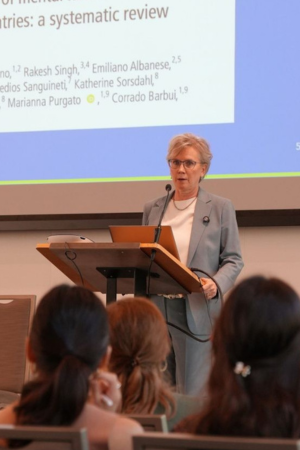


“What struck me most was the thoughtfulness and care people brought to their work, asking questions that matter and reflecting deeply on the implications,” said Dr. Eve Puffer, director of CGMH. “That gives me real hope about where Duke is headed, even in such a challenging time for global health.”
Reflecting the theme of the conference, “Now More Than Ever: Addressing the Global Imperative of Mental Health Equity,” presenters underscored the urgency of addressing a rising global need for mental health services, even as funding for such work is challenged.
“Partnerships, partnerships, partnerships,” stressed speaker Dr. Florence Jaguga, director of mental health services at Moi Teaching and Referral Hospital in Kenya, “We need to work with the government, with the community, with people who have lived experience.”
Keynote speaker Dr. Kathleen Sikkema, Interim dean of the Columbia Mailman School of Public Health and a former DGHI professor, emphasized the importance of social and structural determinants—such as poverty, education and food insecurity—in shaping mental health at the population level.She argued that work in global mental health must “extend beyond psychologists and psychiatrists” toward an “integrated public health approach” that incorporates social scientists, clinicians, policymakers and community members to address the complex systems that affect mental health.
This perspective was visible throughout the conference’s plenary and symposium sessions, which showcased a diverse array of topics, including trauma and resilience, child and family wellbeing, intervention strategies for alcohol-use disorder, cultural adaptation of screening tools, mental health among clergy and innovations in mental health treatment. A particular focus this year was the intersection between climate and mental health, with presentations from three CGMH and DGHI Climate Initiative pilot grant awardees, who are examining how factors such as pollution exposure, resource loss, displacement and climate anxiety can exacerbate mental health conditions in vulnerable populations in the Philippines, South Africa and Sri Lanka.

More than 300 people, representing 51...
Dr. Emily Cherenack, an assistant professor with DGHI and the Department of Psychiatry and Behavioral Sciences, highlighted the intertwined nature of mental health conditions and non-communicable diseases (NCDs) globally. Drawing from her own work and that of additional Duke scholars—including DGHI faculty Rae Jean Proeschold-Bell and Charles Muiruri—she described how poor mental health is linked to chronic disease symptoms and how integrated interventions can address these overlapping burdens of disease.
Dr. Jaguga, who spent several weeks at Duke this semester as a DGHI visiting scholar, described her multifaceted work to improve mental health in Kenya, including advocating for policy reforms, integrating mental health programs into primary care clinics and schools, and task-shifting mental health interventions by training lay providers to deliver support.
Duke's Center for Global Mental Health...

The conference also created opportunities for students and trainees to connect with one another and present their work. Undergraduate and graduate students made 31 in-person poster presentations on topics ranging from stigma and cancer care in Tanzania, to family engagement in psychosocial interventions for Latine families in North Carolina, to the mental health burden among prison inmates in Sri Lanka. In addition, 19 virtual poster presentations were showcased online and on screens throughout the venue, highlighting the work of global colleagues and partners of CGMH.
To further enhance education and training, CGMH recently launched the Duke Global Mental Health Trainee Group, which includes more than 130 students and trainees from Duke, UNC and across the globe. The center, which now comprises 62 affiliate faculty and a broad network of global collaborators, has also started a working group to explore the intersection of religion and mental health, and it continues to grow its partnerships across East Africa and Southeast Asia.
“The highlight of this conference for me was seeing the remarkable growth in our partnerships, with representation from every part of the world,” said Dr. Brandon Knettel, CMGH’s associate director. “This brings so many opportunities for us to expand our reach and learn from one another.”
Those interested in collaborating with the center, joining its affiliate faculty, or learning more about its training and working groups should inquire at dukegmh@duke.edu.
Countries:
Related News


Research News
Herman Pontzer: Why exercise doesn’t burn more calories — and why that’s not the point
January 15, 2026